

A new release date trailer for Outward 2 has confirmed that the survival-focused fantasy RPG will launch in Early Access on PC on July 7. Returning players to the world of Aurai, the sequel is once again built around the idea that adventure should feel dangerous, demanding and deeply human rather than simply empowering players from the opening moments.
Outward 2 is being designed as a simulation of an adventurer’s life, where leaving the safety of town is a serious decision rather than a casual step into the wilderness. The world of Aurai is described as beautiful but perilous, filled with harsh landscapes, dangerous creatures and environmental pressures that can be just as threatening as combat itself. Hunger, thirst, exhaustion and weather all play a role in survival, meaning preparation is central to every journey.
The game continues the first Outward’s emphasis on vulnerability. Players are not cast as legendary heroes capable of cutting through every enemy without consequence. Instead, they begin as ordinary people who must earn their growth, learn from mistakes and use the right tools to survive. That philosophy shapes almost every part of Outward 2, from travel and equipment choices to combat preparation and long-term character development.
There are no mounts or fast travel systems to make exploration easier, so planning each trip matters. Players will need to think about what food and drink to bring, which tent to sleep in, which backpack to carry and how much weight they can realistically manage. Even armour choice involves trade-offs, with heavier gear affecting movement speed while different materials provide protection against certain weather hazards.
Combat is also being expanded with a flexible and responsive system that allows players to chain movements and actions together more fluidly. The developers describe transitions from dodge steps into rolls, attacks, blocks and skills, with players probing enemy defences until they stagger and become vulnerable to heavier punishment. That makes timing, positioning and tactical awareness just as important as raw damage output.
Weapon variety remains a major part of the experience. Every weapon type has its own moveset, and players can wield equipment in both hands to create a wide range of combinations. Sword and shield, dual axes, mace and pistol, lantern and chakram are all given as examples, suggesting that character builds can be shaped around very different approaches to survival and combat.
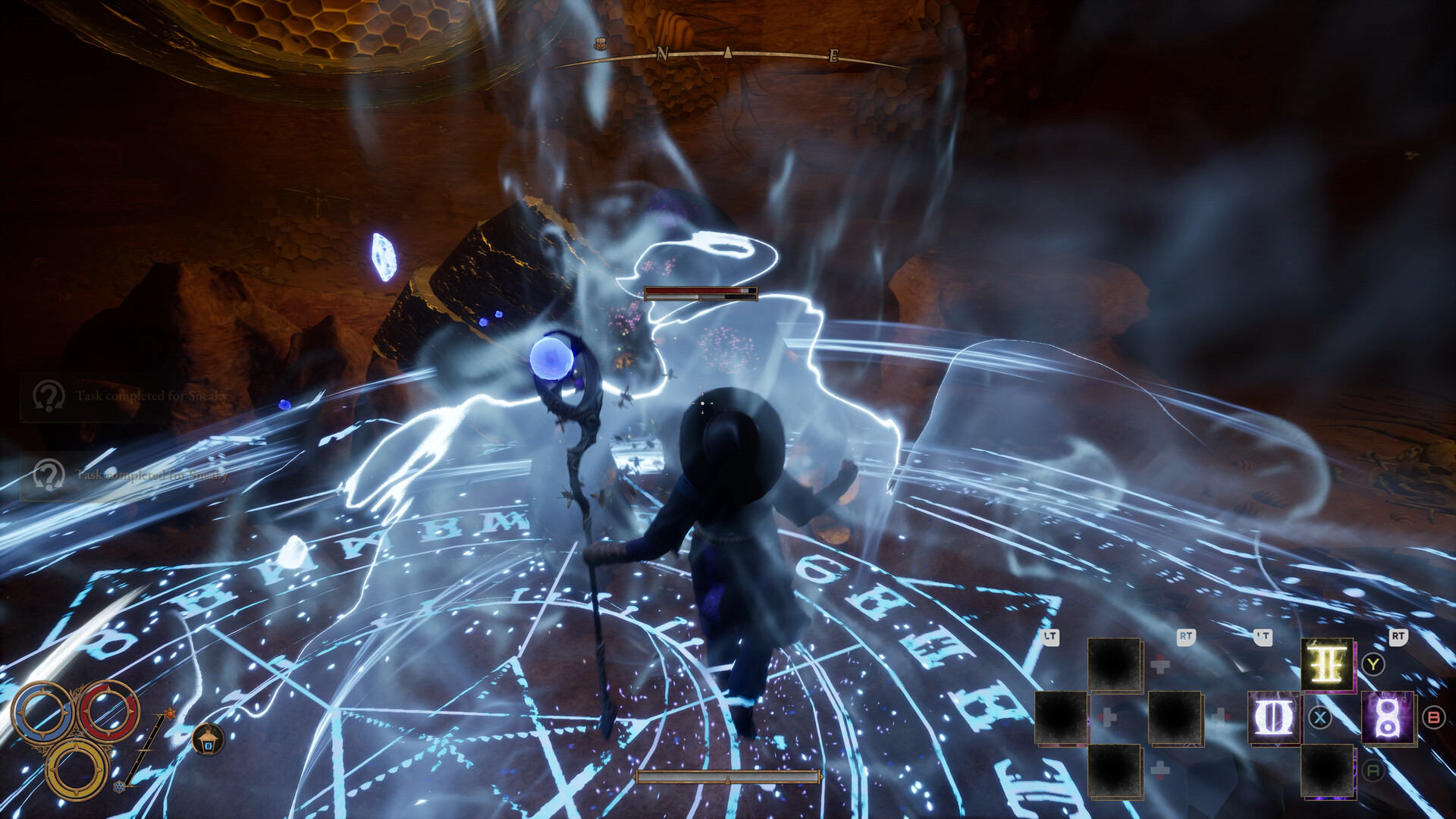
Magic remains deliberately involved rather than instant or effortless. Players do not begin with magical affinity as a commoner, and spellcasting requires a combination of actions and reagents. The blurb references possibilities such as interacting with a Sigil of Darkness or drawing runic words for protection, reinforcing the idea that magic in Outward 2 is something to be studied, prepared and executed carefully rather than treated as a simple button press.
Character progression is shaped through trainers found across Aurai. By paying to learn from them, players can specialise in up to three classes at once, allowing for hybrid builds and personal experimentation. A player may become a heavily armed warrior, a bow user relying on traps, a mage drawing on elemental sigils, or something that blends several approaches together.
Outward 2 also places strong emphasis on consequences. Defeat does not simply mean reloading at the nearest checkpoint as if nothing happened. Being knocked out can lead to different outcomes, from being rescued by a passing traveller to waking up injured in town, robbed, abandoned or worse. The game’s constant auto-saving is designed to discourage reckless decisions and make failure part of the adventure rather than a temporary inconvenience.
For players wanting even higher stakes, Hardcore mode is available with a serious penalty. In that mode, every defeat carries a 20% chance of permanently ending the adventure by deleting the save file. That feature reinforces the game’s wider survival philosophy, where risk assessment and preparation are just as important as skill in the moment.
The game will also be fully playable in both online and split-screen co-op. Players can drop in and out of each other’s worlds for a full journey or a single quest, although the developers note that there is no matchmaking system. That means those looking for online companions will need to organise sessions themselves, including through the game’s Discord community.
Character creation appears much broader this time around. Players begin by choosing one of three starting scenarios: a miner hoping to find wealth in the northern mountains of Tramontane, a homeowner in the underground city of Haboob, or a vagrant struggling to survive in Simeon’s Bastion. Backgrounds and personality traits then add further definition, with examples including family lineage, religious devotion, or traits such as Hoarder, Gourmet and Lone Wolf. These choices affect dialogue options, starting gear and initial aptitudes.
The story also places players within a conflict larger than themselves. The Immaculates, once feared as monstrous beings known as the Scourge, have been pacified by a powerful runic spell. Unable to reproduce and still burdened by their past, they now seek meaning and acceptance in a world that has not forgotten the damage caused by the Scourge. Depending on the faction chosen, players will see different perspectives on their struggle and the consequences that follow.
Those factions include a budding mercenary company, a society of historians seeking political relevance by uncovering Aurai’s mysteries, and a humanitarian mission focused on helping those in need. Each path appears to connect the player’s personal journey with the broader question of the Immaculates’ place in the world.
With its July 7 Early Access launch now confirmed for PC, Outward 2 is positioning itself as a demanding survival RPG where every expedition, defeat and decision matters. Its focus on preparation, consequence, co-op adventuring and human vulnerability suggests a sequel that aims to deepen the identity of the original while giving players more ways to shape their own harsh journey through Aurai.


